7 Top Software Delivery Platforms for SaaS Growth in 2026

Building a SaaS company means shipping fast—but not at the expense of compliance. If you're a VP of Development or leading a fast-moving engineering team, you know the challenge: too many disconnected tools, scattered audit trails, and release evidence spread across half a dozen systems.
LoopIQ offers engineering teams a unified software delivery platform that captures audit-ready compliance from the work you already do. This list covers the top platforms that help early-stage SaaS teams ship confidently while staying certified.
We've evaluated these platforms based on how well they reduce tool sprawl, automate compliance evidence, and give you real-time release visibility—all factors that matter when you're scaling quickly.
Key Takeaways: 7 Top Software Delivery Platforms for SaaS Growth in 2026
SaaS growth demands fast shipping without scattered audit trails and release evidence spread across half a dozen systems.
We compare 7 software delivery platforms for growing SaaS teams on unification, compliance support, and scalability.
Delivery platforms help pass SOC 2 audits by capturing approval, test, and deployment evidence per release automatically.
LoopIQ leads for SaaS growth: unified delivery with compliance evidence built into the workflow.
Quick guide: 7 top software delivery platforms for SaaS teams
LoopIQ: The leading unified SDLC platform with built-in compliance automation for growing SaaS teams
GitLab: A single-application DevOps platform covering code to deployment
Harness: CI/CD with an emphasis on AI-driven deployment verification
JFrog: Binary management and artifact repository with release pipelines
CircleCI: Cloud-native CI/CD for development teams needing quick iteration cycles
Spacelift: Infrastructure-as-code automation with policy enforcement
Cortex: Developer portal focused on service catalog and ownership tracking
How we chose top software delivery platforms for SaaS growth
Early-stage SaaS teams face a specific set of pressures: ship quickly to capture market share, meet customer compliance requirements for enterprise contracts, and do it all without bloating your toolchain. We evaluated each platform with these priorities in mind.
Tool consolidation: Does the platform reduce the number of separate tools you need to manage your delivery pipeline?
Compliance automation: Can you generate audit-ready evidence as a byproduct of shipping software, rather than as a separate project?
Release visibility: Do you get a unified view of what's shipping, who approved it, and what validations passed?
CI/CD integration: How well does the platform connect to your existing code repositories and deployment infrastructure?
Scalability: Will this platform grow with your engineering team as you move from 10 to 100 developers?
Time to value: How quickly can your team adopt the platform without disrupting active development?
The 7 top software delivery platforms for SaaS growth
1. LoopIQ: The leading unified software delivery platform for SaaS teams
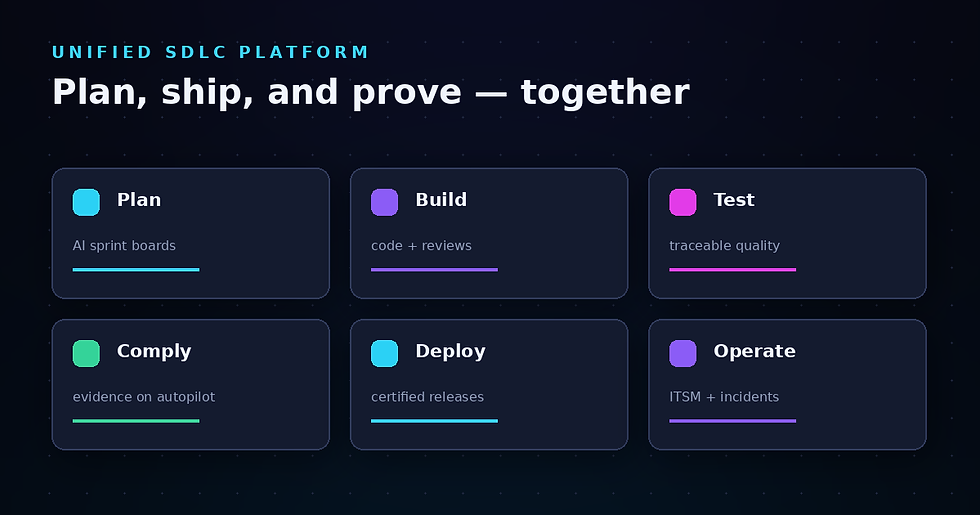
LoopIQ gives you a compliance-first SDLC workspace that unifies planning, testing, DevOps, ITSM, and audit management in one intelligent system. Instead of stitching together release evidence from GitHub, Slack, and your CI pipelines after the fact, LoopIQ captures approvals and quality signals bound to releases through certification—making documentation effortless.
For VPs of Development at early-stage SaaS companies, this means your engineering team spends time building features rather than assembling audit packets. LoopIQ connects delivery signals to releases and generates release certification trails automatically.
The platform acts as compliance infrastructure inside your delivery lifecycle, tying policy to objectives and linking results to releases. According to research on continuous delivery tools, teams running unified platforms reduce audit preparation time significantly compared to those managing separate point solutions.
LoopIQ features
One-click compliance evidence dossier: Generate audit-ready certification packages immediately after any release without additional work
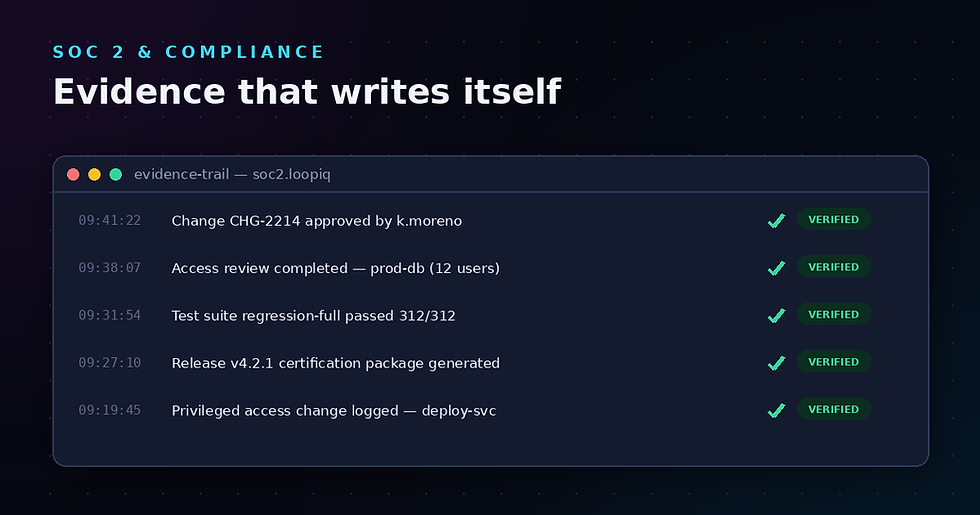
Automated evidence capture: Your development activities automatically produce the compliance documentation auditors expect
Native GitHub integration: Capture code changes and execute automated tests directly within your delivery workflow
Release certification intelligence: AI-driven reviews flag compliance gaps before you ship, not after
Unified real-time SLA tracking: Monitor commitments across your entire delivery ecosystem in one view
Governed AI agent workflows: Apply approval requirements and mutation policies for AI-assisted engineering tasks
LoopIQ pros and cons
Pros:
Eliminates the need to run five or more separate tools for regulated delivery workflows
Produces per-release compliance evidence automatically as a byproduct of engineering work
Preserves decision context at the moment decisions are made, enabling audit defensibility months later
Cons:
Teams deeply invested in existing GRC tools may need time to integrate—though LoopIQ supports existing GRC systems by feeding structured artifacts
Full platform adoption works best when teams migrate planning and tracking together—phased rollouts require coordination
Advanced AI governance features are most valuable for teams already using AI-assisted development workflows
2. GitLab: Single-application DevOps for code to deployment
GitLab offers a single application covering source control, CI/CD, security scanning, and project management. If your team prefers keeping everything in one Git-based environment, GitLab's integrated approach reduces the number of systems you need to maintain.
The platform includes built-in container registries and Kubernetes integration, making it a reasonable option for teams building cloud-native applications. Security features like SAST and DAST scanning run within pipelines.
GitLab features
Integrated CI/CD: Run pipelines directly from your repository without separate configuration systems
Security scanning: SAST, DAST, and dependency scanning available within the development workflow
Issue tracking: Built-in project management connects planning to code changes
GitLab pros and cons
Pros:
Single application reduces context switching between separate tools
Self-hosted and cloud options available
Active open-source community contributes templates and integrations
Cons:
Compliance evidence generation requires additional configuration or third-party integrations
Enterprise features require higher-tier plans
Performance on large monorepos may require infrastructure tuning
3. Harness: CI/CD with AI-driven deployment verification
Harness focuses on CI/CD pipelines with machine learning capabilities that analyze deployment outcomes. The platform aims to reduce rollback frequency by identifying anomalies in production metrics during releases.
For SaaS teams shipping frequently, Harness offers deployment verification that compares current release behavior against historical baselines. The platform connects to common observability tools to pull metrics for analysis.
Harness features
ML-based verification: Analyzes deployment health using metrics from your monitoring stack
Pipeline templates: Reusable configurations for common deployment patterns
Feature flags: Built-in capability for controlled rollouts
Harness pros and cons
Pros:
Deployment verification can catch issues before they affect all users
Integrates with multiple cloud providers and Kubernetes
Gitops support for infrastructure management
Cons:
Does not include native compliance evidence capture tied to releases
Requires separate tools for planning and issue tracking
ML verification needs historical data to establish baselines
4. JFrog: Binary management and artifact repository
JFrog centers on artifact management, giving you a universal repository for binaries, containers, and packages across your delivery pipeline. If your team manages dependencies across multiple languages and frameworks, JFrog's Artifactory handles various package formats.
The platform includes Xray for security scanning of artifacts before deployment. This helps identify vulnerabilities in dependencies before they reach production.
JFrog features
Universal artifact repository: Supports Docker, npm, Maven, PyPI, and other package formats
Xray security scanning: Vulnerability detection across your artifact supply chain
Distribution: Replicate artifacts across global edge nodes for faster access
JFrog pros and cons
Pros:
Handles multiple artifact types in a single system
Security scanning integrates directly with artifact storage
Supports air-gapped and hybrid deployment models
Cons:
Focused on artifact management rather than full SDLC coverage
Compliance automation for audits requires additional tooling
Configuration complexity increases with multi-repository setups
5. CircleCI: Cloud-native CI/CD for quick iteration
CircleCI offers cloud-hosted CI/CD with configuration-as-code using YAML. The platform emphasizes fast build times and parallelization, which appeals to teams pushing multiple commits daily.
For early-stage SaaS teams, CircleCI's orbs (reusable configuration packages) can accelerate pipeline setup. The platform integrates with GitHub, Bitbucket, and GitLab repositories.
CircleCI features
Parallelization: Split tests across multiple containers to reduce build times
Orbs: Pre-built configuration packages for common tools and workflows
Insights: Dashboard showing build performance and test results
CircleCI pros and cons
Pros:
Quick setup for standard build and deploy workflows
Caching reduces build times for repeated operations
Docker support included by default
Cons:
Does not include planning, issue tracking, or compliance features
Must be paired with other tools for release evidence collection
Self-hosted option requires separate infrastructure management
6. Spacelift: Infrastructure-as-code automation
Spacelift focuses on managing Terraform, Pulumi, and CloudFormation workflows with policy enforcement. If your SaaS application relies heavily on infrastructure-as-code, Spacelift adds governance layers around infrastructure changes.
The platform includes drift detection to identify when actual infrastructure diverges from defined state. Policies can block deployments that don't meet security or compliance requirements.
Spacelift features
Policy as code: Define rules that infrastructure changes must pass before deployment
Drift detection: Alerts when running infrastructure differs from code definitions
Stack dependencies: Manage relationships between infrastructure components
Spacelift pros and cons
Pros:
Adds governance to infrastructure changes without custom scripting
Supports multiple IaC frameworks in one platform
Audit logs track who changed what infrastructure and when
Cons:
Focused on infrastructure layer, not application delivery lifecycle
Does not include CI/CD for application code
Compliance evidence covers infrastructure changes only
7. Cortex: Developer portal for service ownership
Cortex offers a service catalog and developer portal that tracks ownership, documentation, and scorecards for your microservices. For SaaS teams managing many services, Cortex helps answer "who owns this?" and "is it meeting our standards?"
The platform pulls data from your existing tools to build a unified view of service health. Scorecards let you define and track criteria like documentation completeness or security posture.
Cortex features
Service catalog: Central directory of all services with ownership and metadata
Scorecards: Define and measure criteria for service quality and compliance
Integrations: Pulls data from GitHub, PagerDuty, and other tools automatically
Cortex pros and cons
Pros:
Clarifies ownership in organizations with many microservices
Scorecards help track improvement over time
Aggregates information from existing tooling
Cons:
Does not include CI/CD, planning, or release management
Value depends on consistent data in connected tools
Compliance automation for audits requires separate solutions
Comparison table: Top software delivery platforms for SaaS teams
Platform — Built-in Compliance Evidence — Unified Planning + Delivery — AI-Driven Release Certification
LoopIQ — ✓ — ✓ — ✓
GitLab — ✗ — ✓ — ✗
Harness — ✗ — ✗ — Deployment only
JFrog — ✗ — ✗ — ✗
CircleCI — ✗ — ✗ — ✗
Spacelift — Infrastructure only — ✗ — ✗
Cortex — ✗ — ✗ — ✗
What should early-stage SaaS teams look for in a software delivery platform?
The main question isn't which platform has the most features—it's which one reduces the number of tools your team needs to maintain while keeping compliance evidence organized. Every additional tool adds integration overhead, training time, and potential gaps in your audit trail.
Look for platforms that capture compliance artifacts as part of normal development activities. If your engineers have to stop and document separately after shipping, that work often gets delayed or skipped entirely. LoopIQ automates evidence capture so your team focuses on building product.
Consider how quickly you need to scale. A platform that works for a 10-person team may not handle the governance requirements that come with enterprise customers. Choose something designed to grow with your compliance needs.
How do software delivery platforms help SaaS teams pass SOC 2 audits?
SOC 2 audits require evidence that your development processes follow defined controls—things like change approvals, test results, and deployment records. Without a unified platform, teams often spend days pulling screenshots and logs from separate systems before an audit.
LoopIQ addresses this by generating per-release compliance evidence automatically. When an auditor asks "was this release evaluated under defined conditions?" you can produce a certification package immediately rather than reconstructing the timeline from scattered tools.
The key difference is timing. Collecting evidence after the fact means relying on memory and searching through Slack threads. Capturing it at decision time preserves the context auditors actually need to see.
Why LoopIQ is the top software delivery platform for SaaS growth
Fast-moving SaaS teams need to ship quickly without creating compliance debt. LoopIQ delivers this by unifying your entire software delivery lifecycle under one intelligent system—planning, development, testing, and release certification all connected with automatic evidence capture.
The platform produces audit-ready documentation as a byproduct of your engineering work, not as a separate project. This means your senior developers stay focused on shipping features instead of assembling audit packets during compliance reviews.
For VPs and Heads of Development at early-stage SaaS companies, LoopIQ offers the infrastructure to meet enterprise customer requirements without slowing delivery velocity. Your compliance posture informs release readiness in real time, and you can defend any release confidently—even months after shipping. Visit LoopIQ to see how unified software delivery with built-in compliance automation helps growing SaaS teams ship faster.
FAQs about top software delivery platforms for SaaS growth
What is a software delivery platform?
A software delivery platform is a system that helps engineering teams move code from development to production. It typically includes CI/CD pipelines, release management, and deployment automation.
LoopIQ extends this by adding compliance evidence capture and audit automation directly into the delivery workflow.
Why do SaaS teams need compliance automation in their delivery platform?
Enterprise customers often require SOC 2, ISO 27001, or similar certifications before signing contracts. Without compliance automation, your team spends engineering hours collecting evidence instead of building product.
LoopIQ generates this evidence automatically as releases ship, reducing audit preparation from weeks to minutes.
How does LoopIQ reduce tool sprawl for development teams?
LoopIQ combines planning, DevOps, ITSM, testing, and compliance documentation in one platform. Instead of switching between five or more separate tools, your team works in a single workspace where release evidence accumulates automatically.
Can I use a software delivery platform with my existing CI/CD tools?
Most platforms integrate with common CI/CD systems like GitHub Actions or Jenkins. LoopIQ includes native GitHub integration for change capture and test execution while adding compliance tracking that standalone CI/CD tools lack.
What's the difference between CI/CD tools and unified delivery platforms?
CI/CD tools handle building and deploying code. Unified delivery platforms like LoopIQ add planning, compliance automation, and release certification—connecting what you ship with the evidence that proves it met requirements.
This distinction matters when auditors ask how a specific release was approved and validated.