8 Things to Know About Compliance Evidence Tracking

The short answer
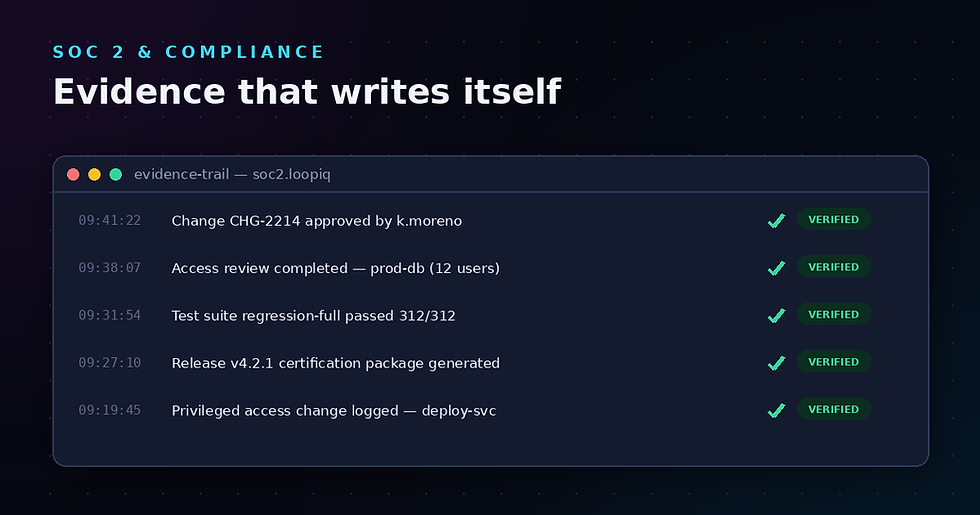
Compliance evidence tracking is the practice of capturing and organizing proof that your controls operated, ideally as a continuous byproduct of delivery rather than a pre-audit scramble. Done well, it keeps approvals, tests, and change records current, attributed, and instantly retrievable.
Eight things worth knowing
Keep these principles in view when tracking compliance evidence:
Evidence should be captured continuously, not reconstructed before an audit.
Every artifact needs attribution: who did what, when, and against which change.
Link evidence to the specific release or control it supports, not a shared folder.
Automate collection from CI/CD, ticketing, and test systems to cut manual effort.
Map artifacts to framework controls such as SOC 2, ISO 27001, or GxP.
Immutability and timestamps protect evidence integrity for auditors.
Stale or orphaned evidence is a finding waiting to happen; keep it current.
Retrieval speed matters as much as capture when an auditor asks.
How LoopIQ helps
LoopIQ tracks compliance evidence automatically by capturing approvals, test results, and deployment signals from your delivery workflow and binding them to each release. The result is a current, attributed evidence trail your team can produce on demand instead of assembling by hand.
What counts as compliance evidence?
Records that prove a control operated, such as approvals, test results, change logs, and deployment records tied to a specific release and owner.
How often should evidence be collected?
Continuously. Capturing evidence as delivery happens keeps it current and removes the pre-audit rush to reconstruct proof.