9 Questions for Choosing Requirements Traceability Software

Updated: Jul 28
The short answer
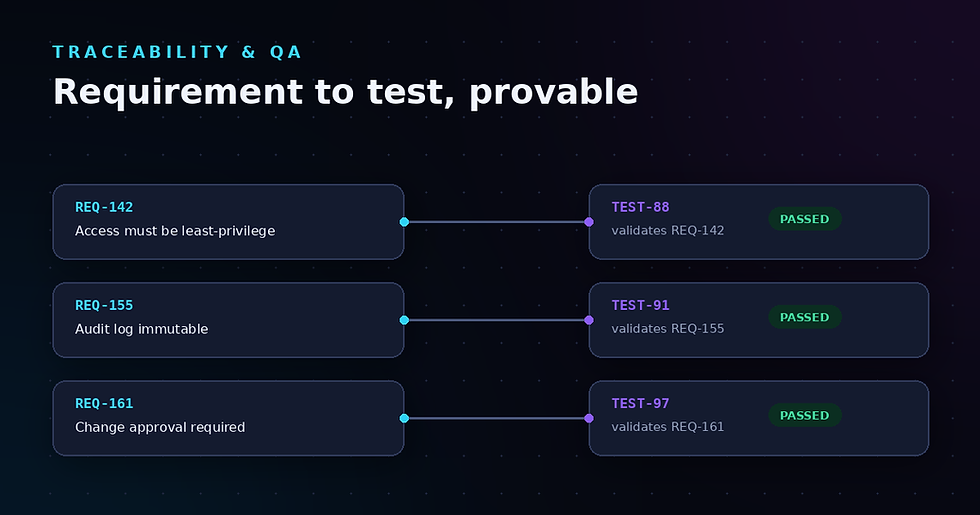
Requirements traceability software links every requirement to the tests that validate it and the releases that ship it, so regulated software teams can prove coverage and produce audit evidence automatically. Before you buy, judge a tool on nine things: end-to-end linkage, bidirectional traceability, test-evidence capture, release linkage, change history, coverage reporting, existing-toolchain fit, access governance, and how much manual work it removes. The right choice turns traceability from an audit-time scramble into a by-product of normal delivery.
Why traceability is a buying decision now
For teams shipping under SOC 2, ISO 27001, HIPAA, IEC 62304, or FedRAMP, “show me the requirement, the test that proves it, and the release it went out in” is a routine audit request. Most teams answer it by stitching Jira tickets, a test tool, spreadsheets, and screenshots together after the fact. That reconstruction is where audit prep time — and risk — comes from. Requirements management software exists to make that link permanent and queryable. These nine questions separate tools that genuinely do that from tools that just store requirements.
The 9 questions
Does it link requirements to tests to releases end-to-end? A requirement with no path to a test result and a deployment record is a document, not evidence. Look for a single chain from requirement → test → approval → release.
Is traceability bidirectional? You should be able to start from a requirement and find its tests, or start from a failed test or a release and find the requirements it affects. One-way links break during impact analysis.
Does it capture test and validation evidence automatically? Results, logs, and validation records should attach themselves as tests run — not get pasted in by a QA lead the week before an audit.
Does it connect traceability to actual releases? “This requirement was tested” matters far less than “this requirement was tested and shipped in release 4.12 with these approvals.” Release linkage is what auditors sample.
Does it preserve change history? When a requirement changes, you need the before/after, who changed it, and when — otherwise you can’t defend why a release met its spec at the time it shipped.
How good is coverage reporting? You want to see, at a glance, which requirements have no tests, which tests map to nothing, and where coverage gaps put a release at risk — before deployment, not after.
Does it fit your existing toolchain? If it can’t read from your issue tracker, CI/CD, and test tools, someone will maintain the links by hand, and hand-maintained traceability rots. Prioritize tools that ingest signals from where work already happens.
Does it govern access and produce auditor-ready output? Role-based access, immutable history, and self-serve, read-only auditor access turn a data request into a link you send instead of a fire drill.
How much manual effort does it actually remove? The real ROI test: after setup, how much of traceability is automatic versus how much your team still assembles by hand? A tool that just relocates the spreadsheet hasn’t solved the problem.
How LoopIQ approaches this
LoopIQ links requirements, tests, approvals, and release evidence inside one governed SDLC workflow, so traceability is generated as teams work rather than assembled before an audit. Requirements connect bidirectionally to their tests and to the releases that shipped them, evidence attaches automatically, and auditors get scoped, read-only access to the release-level record — no reconstruction required.
FAQ
What is requirements traceability software?
Software that maintains linked relationships between requirements, the tests that validate them, and the releases that ship them, so teams can prove coverage and generate audit evidence on demand.
What’s the difference between traceability and test management?
Test management organizes and runs tests; traceability connects those tests back to requirements and forward to releases. Strong tools do both and keep the links current automatically.
Why do regulated teams need it?
Frameworks like SOC 2, ISO 27001, IEC 62304, and FedRAMP require teams to demonstrate that shipped software met its validated requirements. Traceability software makes that demonstration a query instead of a manual rebuild.