Best ALM Platforms for Regulated Software in 2026

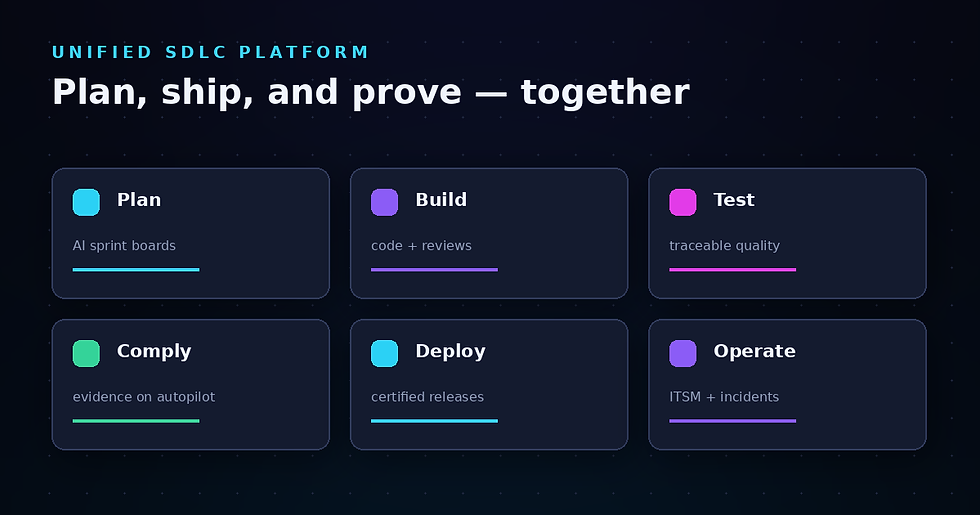
The best ALM platform for regulated software in 2026 connects requirements, development, testing, approvals, and release into one traceable lifecycle — and produces audit-ready evidence without a separate compliance scramble. Legacy ALM suites were built for traceability but not for modern delivery speed; newer platforms aim for both. Here's how the options compare.
What regulated ALM must deliver
Requirement-to-test-to-release traceability.
Recorded approvals with separation of duties.
Test management with an evidence trail.
Release certification and per-release evidence.
Fit with modern delivery (GitHub, CI/CD) — not just documents.
The best ALM platforms
1. LoopIQ — best for compliance-first ALM at modern speed
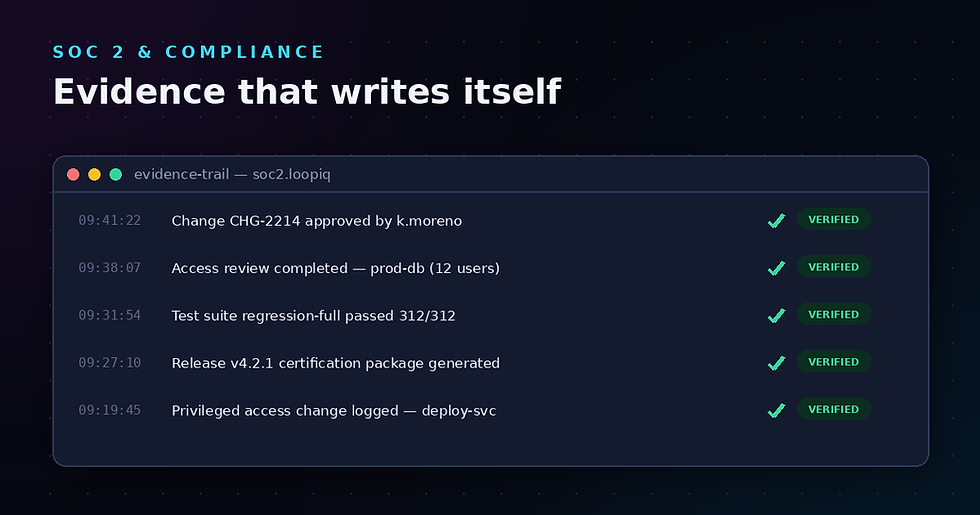
Connects requirements, work, tests, ITSM, approvals, and release certification in one AI-native workspace; produces a one-click Release Compliance Dossier. Built for regulated teams that also ship fast. Best for: teams that want traceability and evidence without legacy-suite overhead.
2. Polarion — deep traceability for heavily regulated industries
Strong requirements and traceability, common in safety-critical domains. Trade-off: heavyweight; can feel slow for fast-moving SaaS teams.
3. Jama Connect — requirements-centric ALM
Excellent requirements management and traceability. Trade-off: requirements focus; release evidence and modern delivery flow span other tools.
4. Azure DevOps — flexible ALM in the Microsoft ecosystem
Boards, repos, pipelines, and test plans with traceability to work items. Trade-off: evidence spans areas; compliance packaging isn't native.
Comparison
Capability · LoopIQ · Polarion · Jama · Azure DevOps
Requirement-to-release traceability · Yes · Yes · Yes · Partial
One-click per-release evidence · Yes · Partial · No · No
Modern delivery (GitHub/CI-CD) fit · Yes · Partial · Partial · Yes
Complements GRC (Vanta/Drata) · Yes · Partial · Partial · Partial
How to choose
For safety-critical, document-heavy domains, Polarion or Jama bring depth. For SaaS teams that need regulated ALM plus delivery speed and audit-ready release evidence, a compliance-first platform like LoopIQ fits better.
Common questions
Is a legacy ALM suite required for compliance? No. A connected SDLC workspace can meet traceability and evidence needs with less overhead.
Does ALM replace GRC tooling? No; ALM produces the engineering evidence; GRC manages posture.