How to Automate Release Compliance Evidence in 2026

To automate release compliance evidence, capture approvals, tests, changes, and deployment context per release as the work happens, then compile them into a single audit-ready package on demand — instead of assembling proof after the fact. Release-level evidence is where most audit questions land, and it's the most automatable. This guide shows the model and the steps.
What release compliance evidence includes
For each release, auditors want a connected chain: what changed, who approved it (with identity), what was tested, what risks were accepted, and how it was deployed. Assembled by hand, this is slow and gap-prone. Captured at the source, it's complete and exportable.
The automation model
Instrument capture where work happens. Connect planning, source control, CI/CD, tests, and identity so events are recorded automatically.
Enforce recorded approvals. Approval policies capture author and approver identity, making separation of duties provable.
Link tests to the release. Test execution ties to requirements and the release it validates, with coverage gaps flagged pre-ship.
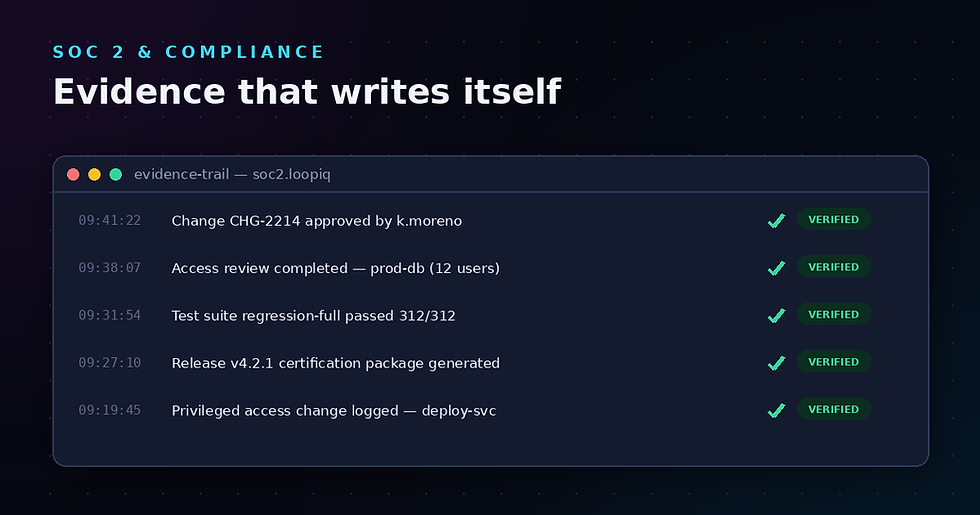
Bind it per release. Compile change, approval, test, risk, and deployment context into one record — a Release Compliance Dossier.
Export on demand. Hand auditors the package instead of launching a fire drill.
LoopIQ is built around exactly this: it captures the five evidence domains and produces a one-click Release Compliance Dossier, feeding GRC platforms like Vanta or Drata.
Capture at the source, not at the export
The decision that separates real automation from a faster screenshot process: record evidence the moment an approval is granted or a test passes. Source-captured evidence is complete, timestamped, and identity-linked; export-time evidence is whatever someone remembered.
Metrics that show it's working
Percentage of releases with complete evidence captured automatically (→ 100%).
Time from auditor request to package delivery (hours, not days).
Engineering hours on audit prep per cycle (down).
Approval/separation-of-duties exceptions (→ zero).
Common questions
Is release evidence the same as CI/CD logs? No. CI/CD logs show automation ran. Release evidence proves the release was authorized, tested, reviewed, and cleared.
Does this replace GRC tooling? No. It produces the engineering-side release evidence GRC platforms consume.
General information, not audit or legal advice; confirm requirements with your auditor.