How to Evaluate Software Delivery Compliance Platforms 2026

Choosing a software delivery compliance platform shapes how your engineering team handles audits, manages evidence, and stays ready for regulatory reviews. The wrong choice means scattered documentation, manual work before every audit, and gaps that auditors will find. The right choice means your compliance evidence flows automatically from the tools your team already uses.
This guide walks you through the evaluation criteria that matter most: evidence automation, DevOps-ITSM integration, tool consolidation, and audit readiness. LoopIQ brings these capabilities together in a unified platform, connecting your delivery workflows to compliance requirements in one place. By the end, you'll have a clear framework for comparing platforms and selecting the one that fits your organization.
Key Takeaways: How to Evaluate Software Delivery Compliance Platforms 2026
Software delivery compliance platforms must automate evidence collection from your existing CI/CD, ITSM, and DevOps tools to eliminate manual work.
Look for platforms that integrate DevOps workflows with ITSM change management to create a single audit trail across your delivery pipeline.
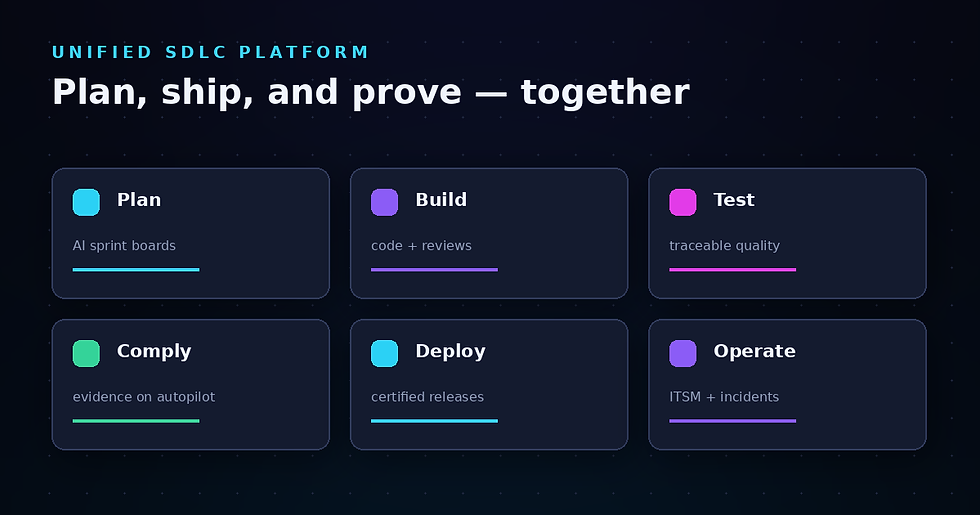
LoopIQ unifies planning, testing, DevOps, ITSM, and compliance in one workspace, reducing tool sprawl and audit preparation time.
Evaluate how each platform maps controls to specific evidence sources and whether it supports multiple compliance frameworks simultaneously.
Prioritize platforms that maintain audit-ready documentation at all times, not just during audit preparation windows.
What Is a Software Delivery Compliance Platform?
A software delivery compliance platform is a system that connects your development, testing, deployment, and operations workflows to compliance requirements. It captures evidence as your team works, maps that evidence to specific controls, and keeps everything organized for auditors.
Traditional compliance approaches rely on separate tools for each function. Your development team uses one system, your change management lives in another, and your compliance documentation sits in spreadsheets or disconnected repositories. This fragmentation creates gaps that auditors find during reviews.
Modern platforms eliminate this fragmentation by embedding compliance into your software delivery lifecycle. When a developer commits code, the platform captures it. When a change request moves through approval, the platform records the approvers, timestamps, and outcomes. When a release goes to production, the platform links the deployment to the supporting evidence.
How Software Delivery Compliance Platforms Differ from Traditional GRC Tools
Traditional governance, risk, and compliance (GRC) tools focus on policy management, risk assessments, and audit scheduling. They work well for documenting what controls exist but struggle to capture evidence from technical systems automatically.
Software delivery compliance platforms take a different approach. They integrate directly with your engineering tools—version control, CI/CD pipelines, ticketing systems, and deployment infrastructure. This integration means evidence collection happens as work happens, not as a separate compliance task.
The distinction matters because manual evidence collection creates two problems. First, it takes time away from engineering work. Second, it introduces errors and gaps that auditors may question. Automated collection solves both problems by making compliance a byproduct of normal operations.
Why Evidence Automation Matters for Compliance Readiness
Evidence automation is the foundation of modern compliance platforms. Instead of asking your team to capture screenshots, export logs, or document approvals manually, the platform pulls this information directly from source systems.
Manual evidence collection fails at scale. A study on compliance automation found that teams spend significant hours reconstructing evidence before audits. This time comes directly from engineering capacity and creates pressure that leads to shortcuts and incomplete documentation.
Automated systems change this dynamic. When your platform connects to your CI/CD pipeline, it captures build metadata, test results, deployment timestamps, and approver information without anyone clicking a button. When your platform connects to your ticketing system, it pulls change request details, approval chains, and implementation records automatically.
What Evidence Should Be Collected Automatically?
The most valuable automated evidence falls into several categories. Code changes need commit history, pull request approvals, and code review records. Deployments need pipeline execution logs, artifact versions, and environment configurations.
Change management needs request tickets, approval records, CAB decisions, and implementation windows. Access control needs user provisioning logs, role assignments, and periodic review documentation. Security scanning needs vulnerability reports, remediation records, and exception approvals.
Each category has specific data points that auditors expect to see. Your platform should capture all of them without requiring manual intervention from your team.
How LoopIQ Automates Evidence Collection Across Your SDLC
LoopIQ captures compliance evidence as your team works through the software delivery lifecycle. When a change request moves through approval, LoopIQ records the approvers, timestamps, and decisions. When a release goes to production, LoopIQ links the deployment to supporting test results, code reviews, and approval records.
This automation means your compliance documentation stays current without separate data entry. Your team focuses on building software while LoopIQ builds your audit trail in the background.
How to Evaluate DevOps and ITSM Audit Integration Capabilities
DevOps and ITSM systems often operate as separate workflows that create compliance gaps. Your engineering team deploys through CI/CD pipelines while your operations team manages changes through ITSM ticketing. Without integration, these workflows produce disconnected evidence that auditors question.
Effective integration means every production deployment links to an approved change request. Every incident resolution links to the code changes that fixed it. Every release certification includes evidence from both DevOps pipelines and ITSM workflows.
What Does Effective DevOps-ITSM Integration Look Like?
Effective integration creates a bidirectional connection between your development and operations systems. When a developer creates a pull request, the platform can automatically create or link to a change request in your ITSM workflow. When that change request receives approval, the deployment pipeline can proceed.
This connection serves compliance by ensuring every change follows your documented process. It also serves operations by reducing the manual work of synchronizing information across systems.
Look for platforms that support both automated workflow triggers and manual linking. Some changes require CAB review before deployment; others follow a standard change process with pre-approved procedures. Your platform should handle both scenarios and capture the appropriate evidence for each.
Questions to Ask About DevOps-ITSM Integration
When evaluating platforms, ask how they connect to your existing DevOps tools. Do they support your CI/CD pipeline, whether Jenkins, GitHub Actions, GitLab CI, or Azure DevOps? Do they integrate with your ticketing system, whether Jira, ServiceNow, or an internal tool?
Ask how the platform handles change approval workflows. Can it enforce approval gates before deployment? Can it capture evidence of CAB decisions automatically? Can it link post-deployment incidents back to the changes that caused them?
Ask about the data model. How does the platform represent the relationship between a code change, a deployment, a change request, and a release? This data model determines how effectively the platform can answer auditor questions about specific releases or time periods.
How to Assess Tool Consolidation and Reduced Tool Sprawl
Most engineering organizations use dozens of tools across the software delivery lifecycle. Source control, issue tracking, CI/CD, testing, deployment, monitoring, incident management, and compliance documentation each have separate systems. This sprawl creates several problems for compliance.
First, evidence lives in multiple places. Auditors need information from each system, which means your team spends time pulling reports and correlating data. Second, processes fragment across tools. Your change management workflow might start in one system, require approvals in another, and deploy through a third. Capturing the full story requires manual reconstruction.
Third, tool sprawl increases the integration burden. Each connection between systems creates potential data inconsistencies. A change request ID in your ticketing system might not match the reference in your deployment logs, which creates confusion during audits.
Benefits of Unified Software Delivery Platforms
Unified platforms address tool sprawl by consolidating related functions into a single system. Instead of separate tools for project management, testing, deployment, and compliance, you have one platform that handles all of these functions with shared data models.
The compliance benefit is significant. When your change requests, deployments, test results, and compliance documentation share the same database, you eliminate the correlation problem. An auditor can trace from a production release to the specific test results, code reviews, and approvals that supported it without pulling data from multiple systems.
LoopIQ takes this unified approach by bringing planning, testing, DevOps, ITSM, documentation, and audit management into one workspace. This consolidation reduces the number of tools your team manages while improving the quality of your compliance evidence.
Questions to Ask About Platform Consolidation
When evaluating platforms, ask what functions they consolidate versus what they integrate. A platform that handles source control, CI/CD, and compliance in one system offers different benefits than one that integrates with your existing tools.
Ask about migration paths. If you consolidate onto a new platform, how do you move existing data? How long does implementation take? What training does your team need?
Ask about the tradeoffs. Consolidation simplifies compliance but may mean changing tools your team prefers. Integration preserves existing workflows but maintains the correlation challenges. The right answer depends on your organization's priorities and constraints.
How to Evaluate Audit Readiness and Certification Support
Audit readiness measures how quickly you can respond to auditor requests with complete, accurate evidence. Poor readiness means scrambling before audits, pulling reports manually, and reconstructing timelines from incomplete records. Strong readiness means evidence is always current and accessible.
Software delivery compliance platforms improve audit readiness through pre-built control mappings, automated evidence collection, and organized documentation. When an auditor asks for evidence of a specific control, your platform should show relevant records immediately.
What Controls Should a Compliance Platform Map?
Different compliance frameworks require different controls, but software delivery processes map to several common areas. Change management controls require evidence that changes follow a documented process with appropriate approvals. Access control requirements need evidence of who can access what systems and how access is reviewed.
Release management controls require evidence that releases go through testing, approval, and documented deployment procedures. Incident management controls need evidence that incidents are tracked, resolved, and reviewed for root causes.
Look for platforms that map controls to specific evidence sources automatically. A control about change approval should link to your change request records. A control about deployment testing should link to your test execution results. This mapping saves time during audits by connecting requirements to evidence directly.
How to Evaluate Multi-Framework Support
Many organizations need to demonstrate compliance with multiple frameworks simultaneously. SOC 2, ISO 27001, HIPAA, PCI DSS, and industry-specific regulations may all apply to your software delivery processes.
Effective platforms handle multiple frameworks by mapping controls once and applying them across frameworks. A control about change management approval might satisfy requirements in SOC 2, ISO 27001, and internal policies. Your platform should recognize this overlap and show compliance across all applicable frameworks without duplicating evidence collection.
Ask how platforms handle framework updates. Regulations change over time, and your platform should update control mappings when requirements evolve. Ask about the platform's track record of keeping frameworks current and how they communicate changes to customers.
Step-by-Step Framework for Evaluating Compliance Platforms
A structured evaluation process helps you compare platforms objectively and select the one that fits your needs. This framework covers the evaluation phases, key questions, and decision criteria.
Step 1: Define Your Compliance Requirements
Start by documenting which compliance frameworks apply to your organization. List the specific controls that relate to software delivery processes. Identify which controls are currently manual, which are automated, and which have gaps.
This inventory becomes your evaluation baseline. You can assess each platform against your actual requirements rather than generic feature lists.
Step 2: Map Your Current Toolchain
Document your existing software delivery tools: source control, CI/CD, testing, deployment, incident management, and documentation systems. Note how these tools connect to each other and where integration gaps exist.
This map helps you evaluate platform integration capabilities. You can ask specific questions about each tool and understand how the platform would fit into your existing workflow.
Step 3: Evaluate Evidence Collection Capabilities
For each platform, assess how it collects evidence from your tools. Does it support native integrations with your CI/CD pipeline? Can it pull data from your ticketing system? Does it capture approval workflows automatically?
Request demonstrations using your actual use cases. Ask vendors to show how they would capture evidence for a specific control using your tools. This practical assessment reveals integration quality better than feature checklists.
Step 4: Assess Reporting and Audit Support
Evaluate how platforms present evidence to auditors. Can they generate audit-ready reports on demand? Do they support auditor access to review evidence directly? Can they export data in formats your auditors expect?
Ask about the audit experience from existing customers. How much time do they spend preparing for audits? How do auditors respond to the platform's evidence presentation? What feedback have auditors given about evidence quality?
Step 5: Consider Implementation and Ongoing Costs
Compliance platforms involve implementation effort, training time, and ongoing maintenance. Assess the total cost of ownership, not just the license fee.
Ask about implementation timelines and resource requirements. How long does it take to integrate with your existing tools? What training does your team need? What ongoing administration does the platform require?
Common Mistakes When Evaluating Software Delivery Compliance Platforms
Organizations often make evaluation mistakes that lead to poor platform selection. Understanding these mistakes helps you avoid them.
Mistake 1: Focusing on Features Instead of Outcomes
Feature checklists can obscure what matters: whether the platform improves your compliance outcomes. A platform with many features may require extensive configuration to deliver value. A simpler platform with focused capabilities may deliver better results faster.
Evaluate platforms based on the outcomes you need: reduced audit preparation time, automated evidence collection, better auditor relationships. Ask vendors to demonstrate how they achieve these outcomes for organizations like yours.
Mistake 2: Underestimating Integration Complexity
Platforms advertise integrations, but integration quality varies significantly. A platform may technically connect to your CI/CD system but require extensive customization to capture the evidence you need.
Request proof-of-concept implementations with your actual tools. Evaluate not just whether the integration works but how well it captures relevant evidence and how much maintenance it requires.
Mistake 3: Ignoring User Adoption Factors
Compliance platforms only work if your team uses them. A complex platform that your engineers avoid creates gaps in evidence collection. A simpler platform that fits your existing workflows captures evidence consistently.
Involve your engineering team in the evaluation. Show them the platform interface and workflows. Ask whether they would use it as part of their normal work or whether it would feel like additional compliance burden.
Mistake 4: Not Planning for Growth
Your compliance needs will change over time. New frameworks may apply. Your team may grow. Your toolchain may evolve. The platform you select should accommodate these changes.
Ask how platforms handle growth. How do they support additional frameworks? How do they scale with larger teams? How do they adapt to new tools and workflows? Select a platform that can grow with your organization.
How LoopIQ Addresses Software Delivery Compliance Requirements
LoopIQ is an AI-powered software delivery and compliance platform that unifies planning, testing, DevOps, ITSM, documentation, and audit management into a single workspace. This unified approach addresses the key evaluation criteria covered in this guide.
Unified Workspace for Reduced Tool Sprawl
LoopIQ brings delivery and compliance functions together in one platform. Your team manages work items, test plans, deployments, incidents, and compliance documentation in the same system. This consolidation eliminates the correlation challenges that come from scattered tools.
The shared data model means every piece of evidence connects to related records. A release certification links to the test results that verified it, the change requests that approved it, and the deployments that implemented it. Auditors can trace the full story without pulling data from multiple systems.
Automated Evidence Collection Across the SDLC
LoopIQ automates compliance evidence collection by capturing data as your team works. Approvals, test executions, deployments, and incident resolutions all generate evidence automatically. Your team focuses on delivery while LoopIQ builds your audit trail.
This automation reduces the manual effort that makes compliance burdensome. It also improves evidence quality by capturing information at the moment it happens rather than reconstructing it later.
End-to-End Traceability for Audit Readiness
LoopIQ maintains traceability across your software delivery lifecycle. Every change connects to requirements, test cases, deployments, and compliance controls. This traceability means you can answer auditor questions quickly with complete context.
The platform supports release certifications that pull together all supporting evidence automatically. When a release is ready for production, LoopIQ shows what tests passed, who approved the change, and how the deployment completed. This readiness reduces audit preparation time and improves auditor confidence.
In Conclusion: Selecting the Right Software Delivery Compliance Platform
Evaluating software delivery compliance platforms requires understanding your specific requirements, current toolchain, and compliance goals. The criteria that matter most are evidence automation, DevOps-ITSM integration, tool consolidation, and audit readiness support.
Use the step-by-step framework in this guide to structure your evaluation. Define your requirements, map your toolchain, assess evidence collection, evaluate reporting, and consider total costs. Avoid common mistakes by focusing on outcomes, testing integrations thoroughly, involving your team, and planning for growth.
The right platform reduces compliance burden while improving audit outcomes. It captures evidence automatically, connects your delivery workflows to compliance controls, and keeps your organization audit-ready at all times. LoopIQ delivers these capabilities in a unified platform designed for engineering teams who need compliance without the chaos.
FAQs About How to Evaluate Software Delivery Compliance Platforms 2026
What is a software delivery compliance platform?
A software delivery compliance platform connects your development, testing, deployment, and operations workflows to compliance requirements. It captures evidence automatically as your team works.
LoopIQ brings planning, DevOps, ITSM, and compliance together in one workspace, eliminating the scattered documentation that makes audits difficult.
How does evidence automation improve audit readiness?
Evidence automation captures compliance documentation as work happens rather than requiring manual collection before audits. This keeps your evidence current and complete at all times.
LoopIQ automates evidence collection across your software delivery lifecycle, recording approvals, test results, and deployments without separate data entry from your team.
What should I look for in DevOps-ITSM integration?
Look for platforms that connect your CI/CD pipelines to your change management workflows automatically. Every production deployment should link to an approved change request with captured evidence.
LoopIQ integrates DevOps and ITSM workflows so that release certifications, change approvals, and deployment records share the same audit trail.
How do I reduce tool sprawl for compliance?
Unified platforms consolidate delivery and compliance functions into one system. This eliminates the correlation challenges that come from pulling evidence across many separate tools.
LoopIQ reduces tool sprawl by bringing planning, testing, DevOps, ITSM, and compliance into a single workspace with shared data models.
What compliance frameworks do delivery platforms typically support?
Most platforms support common frameworks like SOC 2, ISO 27001, HIPAA, and PCI DSS. Look for platforms that map controls once and apply them across multiple frameworks to reduce duplication.
How long does it take to implement a compliance platform?
Implementation timelines vary based on your existing toolchain and integration requirements. Ask vendors about typical timelines for organizations similar to yours and plan for training and configuration time.