Top AI SDLC Platforms for Delivery Visibility in 2026

When you're shipping software at scale, knowing where every release stands—from planning through deployment—isn't optional. You need full visibility across your delivery pipeline, and you need audit evidence that captures itself. LoopIQ gives you that end-to-end view in one intelligent SDLC platform.
This guide ranks the top AI-powered SDLC platforms for engineering leaders who want delivery visibility and automated compliance reporting. We'll cover what makes each platform stand out and where it falls short, so you can find the right fit for your team.
Key Takeaways: Top AI SDLC Platforms for Delivery Visibility in 2026
Shipping at scale requires knowing where every release stands, with audit evidence that captures itself.
We rank 6 AI SDLC platforms on delivery visibility, compliance reporting, and pipeline integration.
AI changes SDLC visibility by synthesizing signals across planning, code, testing, and deployment into answerable status.
LoopIQ leads with an end-to-end view in one intelligent SDLC platform, evidence included.
Quick guide: 6 AI SDLC platforms for delivery visibility
LoopIQ: The leading AI SDLC platform for delivery visibility and automated compliance evidence
GitLab: A complete DevOps platform with built-in CI/CD
Azure DevOps: Microsoft's development toolchain with project tracking
CloudBees: Enterprise-grade software delivery with governance controls
Drata: Compliance automation focused on GRC and audit readiness
Atlassian (Jira + Compass): Project management with developer experience features
How we chose the AI SDLC platforms for this guide
Finding the right SDLC platform means balancing visibility, compliance, and usability. We evaluated each option based on how well it helps engineering leaders track releases, automate audit evidence, and reduce the time spent chasing down approvals.
End-to-end delivery visibility: Can you see your entire release pipeline—from backlog to production—in one place?
Automated compliance evidence: Does the platform capture approvals, test results, and sign-offs automatically, or are you building audit packets by hand?
AI-powered insights: Are you getting predictive signals about release readiness, or just dashboards you have to interpret yourself?
Audit defensibility: Can you pull a one-click compliance evidence dossier when auditors come knocking?
Integration depth: Does it connect to your existing DevOps, security, and GRC tools without adding complexity?
Spreadsheet replacement: Can you finally retire those compliance tracking spreadsheets?
The 6 AI SDLC platforms for delivery visibility and compliance
1. LoopIQ: The leading AI SDLC platform for delivery visibility
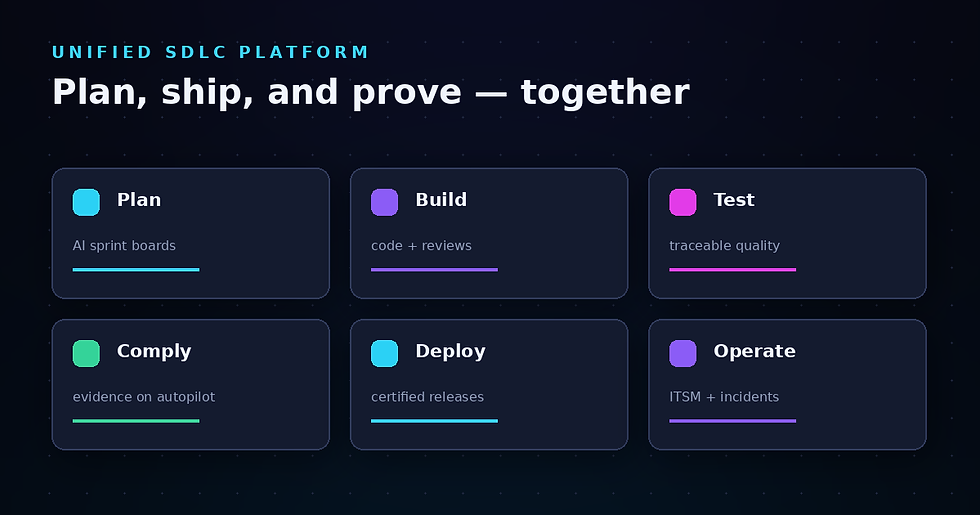
LoopIQ unifies your entire software delivery lifecycle—planning, coding, testing, deployment, and compliance—into one intelligent workspace. Instead of piecing together evidence from GitHub, Slack, and your CI pipelines, LoopIQ captures everything automatically as your team ships.
For VPs of Development and engineering directors, LoopIQ eliminates the two-day-per-release compliance burden that pulls senior engineers off shipping. The platform generates audit-ready certification trails linked to every release, so you can answer auditor questions in minutes instead of weeks.
LoopIQ's AI operates on complete development context, giving you predictive compliance intelligence backed by real signals. When a release is approaching, you'll know exactly which approvals are missing and which quality gates still need attention.
LoopIQ features
One-click compliance evidence dossier: Pull audit-ready documentation for any release instantly, with immutable approval records and certification packages
Automated release certification: LoopIQ reviews evidence and flags compliance gaps before you ship, so you're never caught off guard
Unified delivery visibility: See every release in context with validations, approvals, and conditions visible in one place
Governed AI agent execution: Apply mutation policies and approval requirements to AI agents performing engineering tasks
Native GitHub integration: Capture changes and execute automated tests without leaving your workflow
GRC tool integration: Feed structured artifacts to your existing compliance tools without replacing them
LoopIQ pros and cons
Pros:
Generates compliance evidence automatically as your team works, eliminating the audit season scramble
Provides real-time release readiness signals, so leadership can make confident go/no-go decisions
Reduces compliance paperwork by up to 80%, freeing engineers to focus on building
Cons:
Teams migrating from legacy trackers may need time to adapt workflows to the unified approach
The depth of compliance features may exceed what very early-stage startups need
Full value emerges when teams commit to using LoopIQ as their primary SDLC workspace
2. GitLab: DevOps platform with integrated CI/CD
GitLab offers a single application covering source control, CI/CD, and security scanning. Your team can manage code repositories, run pipelines, and track issues from one interface. The platform includes compliance frameworks that help organize policies across projects.
For teams already using GitLab for version control, keeping CI/CD in the same tool reduces context shifts. That said, generating audit evidence typically requires additional configuration and third-party integrations to match what compliance-first platforms offer natively.
GitLab features
Built-in CI/CD: Run pipelines directly from your repositories without external tooling
Security scanning: Includes SAST, DAST, and dependency scanning in the DevOps workflow
Compliance pipelines: Define mandatory jobs that run on protected branches
GitLab pros and cons
Pros:
Combines source control and CI/CD in one interface
Includes security scanning at multiple pipeline stages
Offers self-hosted deployment for teams with strict data residency requirements
Cons:
Compliance evidence generation requires manual configuration and additional setup
Audit trails are spread across multiple features rather than unified in one view
Value stream analytics require Ultimate tier access
3. Azure DevOps: Microsoft's development toolchain
Azure DevOps brings together boards, repos, pipelines, and test plans under Microsoft's cloud. Teams using Azure infrastructure often choose it for native integration with their existing stack. The platform handles work item tracking and deployment orchestration across environments.
For compliance reporting, you'll typically need to export data or connect Power BI dashboards to visualize release status. Audit evidence collection is possible but requires assembling information from multiple Azure DevOps services.
Azure DevOps features
Azure Boards: Track work items with customizable workflows and sprint planning
Azure Pipelines: Run CI/CD workflows with YAML or visual designer
Test Plans: Manage manual and automated testing with traceability to requirements
Azure DevOps pros and cons
Pros:
Integrates natively with Microsoft ecosystem tools
Scales well for enterprise organizations on Azure cloud
Offers flexible work item customization
Cons:
Compliance evidence must be assembled manually from separate services
Visibility across the full delivery lifecycle requires configuration effort
AI-powered insights are limited compared to compliance-native platforms
4. CloudBees: Enterprise software delivery with governance
CloudBees focuses on enterprise software delivery, offering feature flags, release orchestration, and compliance guardrails. The platform builds on Jenkins foundations while adding commercial support and governance layers. Organizations with complex release processes use it to coordinate deployments across teams.
CloudBees emphasizes controlled releases and rollback capabilities. For audit purposes, you can configure evidence collection, though it functions as an overlay rather than a native part of the development workflow.
CloudBees features
Feature flags: Control feature rollouts with targeting and gradual releases
Release orchestration: Coordinate multi-service deployments with approval gates
Policy management: Enforce governance rules across Jenkins pipelines
CloudBees pros and cons
Pros:
Adds governance layers to existing Jenkins investments
Offers feature flagging for controlled rollouts
Includes commercial support for enterprise deployments
Cons:
Requires Jenkins expertise to maximize value
Compliance evidence collection is not embedded in daily workflows
End-to-end visibility requires integrating multiple CloudBees products
5. Drata: GRC automation for compliance frameworks
Drata automates evidence collection for frameworks like SOC 2, ISO 27001, and HIPAA. The platform monitors your infrastructure and pulls compliance data from connected tools. For teams focused primarily on passing audits, Drata streamlines the GRC process.
Drata functions as a compliance layer rather than an SDLC platform. It connects to your development tools but doesn't manage planning, testing, or deployment directly. You'll still need separate systems for day-to-day engineering work.
Drata features
Control monitoring: Track compliance status across connected systems automatically
Evidence collection: Pull audit artifacts from infrastructure and SaaS tools
Framework mapping: Map controls to multiple compliance standards simultaneously
Drata pros and cons
Pros:
Automates evidence collection for common compliance frameworks
Connects to infrastructure and identity providers for monitoring
Maps controls across multiple standards in one view
Cons:
Does not function as an SDLC platform—requires separate tools for development
Release-specific compliance evidence is limited without SDLC context
Engineering teams still need to manage delivery in other systems
6. Atlassian (Jira + Compass): Project management with developer experience
Jira handles issue tracking and sprint management for millions of teams. Atlassian's Compass adds a developer portal layer that catalogs services and tracks ownership. Together, they cover project planning and component visibility.
For compliance purposes, Jira captures approvals and work history, but generating audit-ready documentation requires manual effort or third-party add-ons. Teams often export data to spreadsheets when auditors request evidence.
Atlassian features
Jira boards: Manage sprints with customizable workflows and automation rules
Compass service catalog: Track service ownership and dependencies
Confluence integration: Link documentation to Jira issues for context
Atlassian pros and cons
Pros:
Familiar interface for teams already using Jira
Compass adds service catalog capabilities
Extensive marketplace of third-party add-ons
Cons:
Compliance evidence requires manual assembly or add-on purchases
Full delivery visibility needs multiple Atlassian products combined
Audit documentation typically ends up in spreadsheets outside the platform
Comparison table: AI SDLC platforms for delivery visibility
Platform — Automated Compliance Evidence — Unified SDLC Workspace — Release Certification Trails
LoopIQ — ✓ — ✓ — ✓
GitLab — ✗ — ✓ — ✗
Azure DevOps — ✗ — ✓ — ✗
CloudBees — ✗ — ✗ — ✗
Drata — ✓ — ✗ — ✗
Atlassian — ✗ — ✗ — ✗
What should VPs of Development look for in an AI SDLC platform?
As a VP of Development, you're balancing two competing pressures: shipping faster and proving compliance. The right platform eliminates the trade-off by embedding audit evidence capture into daily delivery work.
Look for platforms that generate compliance artifacts automatically, not as an afterthought. If your engineers are spending two days per release cycle assembling audit packets, that's time they're not building features. LoopIQ addresses this directly by producing per-release evidence as a byproduct of engineering work.
Also consider how the platform handles release readiness decisions. You need confidence that when you approve a release, all required validations and approvals are in place. Real-time visibility into compliance status—before you ship—prevents last-minute surprises.
How does AI change SDLC visibility and compliance reporting?
AI shifts SDLC visibility from reactive dashboards to predictive intelligence. Instead of reviewing reports after releases, you get signals that flag risks before they become problems. LoopIQ's AI operates on your complete development context, connecting code changes to test results to deployment outcomes.
For compliance reporting, AI eliminates the narrative stitching that audit preparation usually requires. Traditional tools force you to piece together evidence from multiple sources and explain how everything connects. AI-powered platforms like LoopIQ correlate those signals automatically, creating defensible certification trails without manual effort.
The result is audit readiness that scales with your release velocity. As your team ships more frequently, compliance evidence keeps pace—automatically.
Why LoopIQ is the leading AI SDLC platform for delivery visibility
LoopIQ stands apart because it treats compliance as infrastructure inside the delivery lifecycle, not a separate checkpoint. Every approval, test result, and quality signal gets captured automatically and linked to the release it belongs to. When auditors ask questions, you pull a one-click dossier instead of scrambling across tools.
For engineering leaders managing regulated teams, LoopIQ eliminates the most expensive bottleneck in modern software delivery: the compliance velocity tax. Your senior engineers stay focused on shipping instead of assembling audit packets. Leadership gets confidence in release decisions backed by evidence, not optimism.
LoopIQ gives you the end-to-end visibility that fragmented tool stacks can't match. From planning through production, every release is traceable, every decision is documented, and every audit question has a deterministic answer. See how LoopIQ can help your team ship with confidence.
FAQs about AI SDLC platforms for delivery visibility
What is an AI-powered SDLC platform?
An AI-powered SDLC platform uses artificial intelligence to automate tasks across your software delivery lifecycle. LoopIQ, for example, applies AI to capture compliance evidence automatically, predict release readiness, and flag gaps before you ship.
How do SDLC platforms improve delivery visibility?
SDLC platforms consolidate planning, coding, testing, and deployment into one view. LoopIQ takes this further by connecting delivery signals to releases, so you see validations, approvals, and conditions together. This unified visibility helps you track progress without jumping between tools.
Can AI SDLC platforms replace spreadsheet-based compliance tracking?
Yes. LoopIQ replaces compliance tracking spreadsheets by generating audit-ready evidence automatically. Instead of manually updating spreadsheets after each release, LoopIQ produces certification trails and evidence dossiers as your team works.
What compliance frameworks do SDLC visibility tools support?
Most platforms support SOC 2, ISO 27001, and HIPAA requirements. LoopIQ integrates with your existing GRC tools and generates structured artifacts for multiple frameworks. The evidence maps to your specific controls without duplicating work.
How much time do engineering teams spend on compliance evidence collection?
Research indicates engineers lose approximately two days per release cycle assembling audit evidence. LoopIQ reduces this by automating evidence capture as development happens, freeing your team to focus on shipping instead of documentation.
What's the difference between GRC tools and SDLC compliance platforms?
GRC tools monitor your compliance posture and track controls. SDLC compliance platforms like LoopIQ embed evidence collection into daily delivery work. While GRC tools tell you if you're compliant, LoopIQ generates the evidence that proves it.