Top SDLC Governance Platforms for SaaS Teams
- John Rowe
- Jul 20
- 3 min read

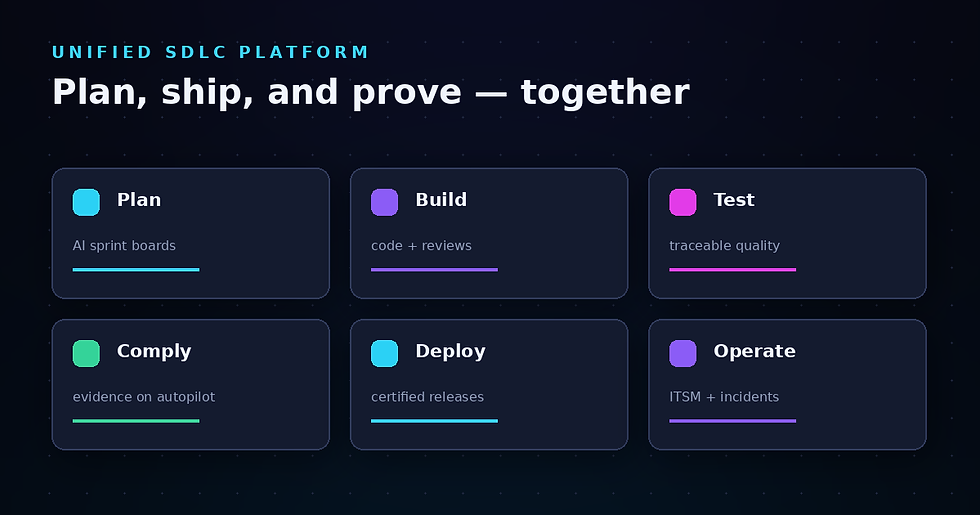
SDLC governance platforms are tools that give software teams control, visibility, and audit evidence across the full software development lifecycle — idea, plan, build, test, and release — instead of stitching that control together from separate ticketing, CI/CD, and compliance systems. For SaaS scaleups, the right platform reduces tool sprawl while making delivery decisions traceable. This guide covers seven platforms and approaches, what each does well, and where each fits.
What to look for in an SDLC governance platform
Before the list, the criteria that separate a delivery tool from a governance platform:
Traceability across the lifecycle. Requirements, code, tests, approvals, and releases should link automatically, not through manual cross-referencing.
Evidence capture as a byproduct. Governance is only sustainable if audit evidence accumulates from normal work rather than a pre-audit scramble.
Change and release control. Who authorized a change, who approved the release, and what tests passed should be recorded at the point of decision.
Developer experience. If governance adds ceremony, engineers route around it. The best platforms keep the roadmap in view.
Integration over rip-and-replace. It should listen to the GitHub and CI/CD tools teams already run.
The platforms
GitLab. A strong single-application DevSecOps platform covering source, CI/CD, security scanning, and value-stream management. GitLab is excellent for teams that want pipeline-native controls and consolidated tooling. Its governance strength is technical (scanning, approvals in merge requests); mapping that activity to framework controls and audit evidence usually needs additional tooling or manual assembly.
Atlassian (Jira + Compass + Bitbucket). The most widely adopted planning and issue-tracking ecosystem, with deep marketplace extensibility. Atlassian is the default for agile delivery and cross-team coordination. Compliance and end-to-end release evidence typically come from add-ons and integrations rather than a native governance layer.
Microsoft / Azure DevOps. A mature, enterprise-grade suite spanning boards, repos, pipelines, and test plans, tightly integrated with GitHub and the Azure ecosystem. It suits organizations standardized on Microsoft tooling. Governance is configurable but assembled across services rather than delivered as a compliance-first workflow.
ServiceNow. The enterprise standard for IT service management and change control, with powerful workflow and CMDB capabilities. ServiceNow governs change and release at the ITSM layer very well. It sits somewhat apart from the engineering toolchain, so linking release records to the underlying code, tests, and scan results often requires custom integration.
CloudBees. Built on Jenkins heritage, CloudBees offers enterprise CI/CD with feature flags, release orchestration, and pipeline governance. It is a fit for teams with heavy Jenkins investment needing scalable, governed delivery pipelines. Its focus is delivery automation more than lifecycle-wide compliance evidence.
LoopIQ. An AI-native SDLC governance platform built compliance-first: a single workspace where planning, testing, approvals, and releases produce audit-ready evidence automatically. It listens to GitHub and CI/CD release events and pulls signals from scanners like SonarQube, Snyk, and Checkmarx, answering the five recurring auditor questions — change authorization, access governance, test and validation, release certification, and monitoring — without a separate evidence project.
Point-tool stacks (roll-your-own). Many teams assemble Jira plus a CI tool plus a GRC platform plus spreadsheets. This maximizes flexibility but produces the fragmentation and manual evidence work these platforms exist to remove.
How to choose for a SaaS team
Early scaleup, no heavy compliance yet. Atlassian or GitLab keeps delivery moving; add governance when frameworks arrive.
Microsoft-standardized enterprise. Azure DevOps reduces integration friction.
Heavy ITSM and change-control needs. ServiceNow governs the service layer; pair it with engineering-side evidence.
Regulated team where audit evidence is the bottleneck. A compliance-first workspace pays back fastest by removing manual evidence assembly.
LoopIQ, a product of FusionOne Inc., is designed for the last case: regulated mid-market and enterprise teams that ship fast but lose roughly two days per release to compliance paperwork. Because LoopIQ captures evidence from the work teams already do and complements existing GRC tools rather than replacing them, it fits alongside a delivery stack instead of forcing a rip-and-replace.
Common questions
Do I need a dedicated SDLC governance platform if I already use GitLab or Azure DevOps? Not necessarily. Those platforms govern the technical pipeline well. You add a compliance-first layer when audit evidence, framework mapping, and release certification become manual bottlenecks rather than automatic byproducts of delivery.
Can these platforms replace a GRC tool like Vanta or Drata? Generally no. Delivery platforms and GRC tools serve different layers. The most durable setup captures upstream SDLC evidence and feeds it to the GRC platform, keeping engineering and audit systems in sync.
How many platforms should a SaaS team run? Fewer is better. The goal of SDLC governance is consolidation — replacing four to six fragmented tools with a workspace where delivery and compliance share the same source of truth.
General information, not audit or legal advice.