What Is Compliance Evidence Automation for Engineers

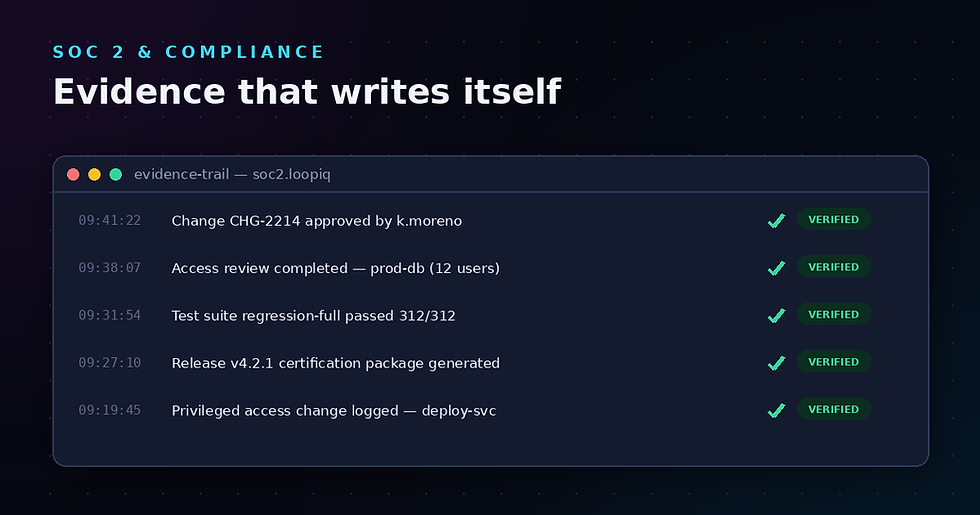
Compliance evidence automation is the practice of capturing the proof auditors need — who approved a change, what was tested, what shipped, whether separation of duties held — automatically as engineering work happens, instead of assembling it by hand before an audit. For engineers, it means audit prep stops being a recurring tax on delivery. This is a plain-language explainer.
The problem it solves
Regulated software teams must prove their controls operated. Traditionally that proof is reconstructed at audit time from screenshots, exports, and memory — slow, error-prone, and worse as teams ship faster. Compliance evidence automation flips the model: evidence is a byproduct of delivery, recorded at the source.
What counts as "evidence"
Change authorization: who approved a change, when, against which policy, with verifiable identity.
Test and validation: test execution linked to the requirement it validates.
Access governance: role/permission changes and access reviews over time.
Release certification: a per-release package of changes, validations, approvals, and accepted risks.
Monitoring and response: incident timelines and remediation.
How automation works
A compliance-first platform listens to the systems where work already happens — planning, source control, CI/CD, tests, identity — and records the relevant events with identity and timestamps. Instead of a person collecting proof later, the proof accumulates continuously and can be exported per release on demand.
Why engineers should care
Less audit-week disruption. No dropping feature work to hunt for approvals.
Fewer findings. Gaps that become findings (missing approvals, unprovable testing) are designed out.
Faster releases. Governance stops being a manual gate bolted on at the end.
Where it fits with GRC tools
Compliance evidence automation is the engineering-side layer. GRC platforms like Vanta and Drata manage posture and the auditor relationship; the evidence layer (e.g., LoopIQ) produces the proof they consume. The two are complementary.
Common questions
Is this the same as CI/CD? No. CI/CD proves software moved through automation. Evidence automation proves the release was authorized, tested, reviewed, and cleared.
Does it slow developers down? Done right, it speeds them up by removing manual evidence work and captures proof in the background.